
Christopher Helali: The Red Diplomat
An interview with ACP International Secretary Christopher Helali

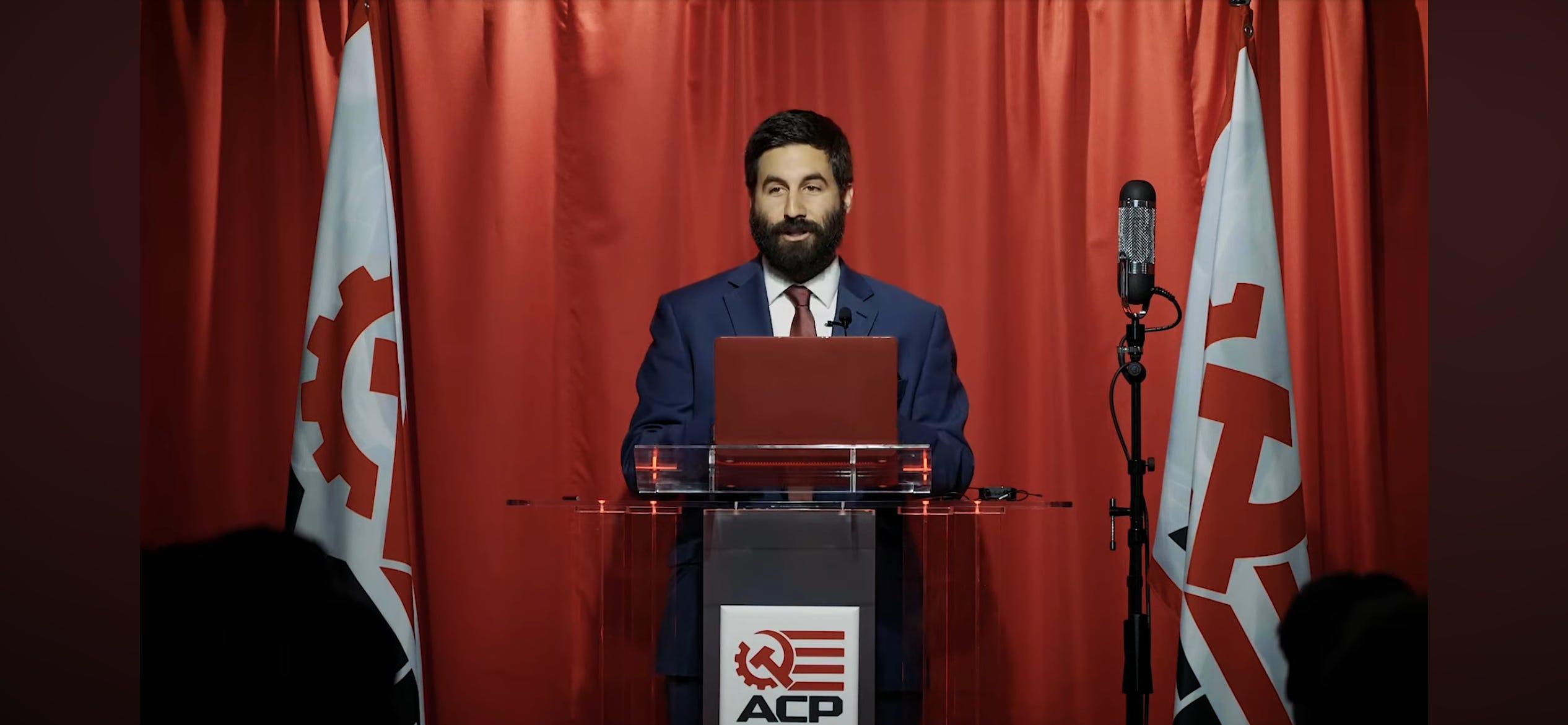
Grant Klusmann: Before realizing you are a Marxist-Leninist, what political activities were you involved in?
Christopher Helali: To begin, I come from a left-wing revolutionary family. My grandparents were members of the communist resistance against the Nazis and the fascist Axis powers and later the Anglo-American imperialists who supported the monarcho-fascists in Greece. My father participated in the Iranian Revolution. So, I grew up in a very politically active household. Very pro-union, working-class oriented, pro-Palestine, supportive of revolutionary and progressive movements, and very much against NATO. I remember my early life being steeped in political debates, activism, and picket lines. I remember being on the picket line with my father during the UPS Teamsters strike as a kid in the 1990s. In thinking about all of this, my political activities before self-identifying as a Marxist-Leninist were well within that camp already. I vividly remember my grandmother telling me that Jesus was the first communist and that if we have more, we should share and we should uplift one another. I think that was sort of the working-class and peasant ideals of the communist movement that were instilled in me and transformed how I saw the world and how I would fight for those oppressed or marginalized. So, my political roots came from my family’s over century-long participation in the communist and revolutionary movements of their respective countries.
Grant Klusmann: You are known for your work as an internationalist. Where do you think your expertise in international geopolitics comes from?
Christopher Helali: First and foremost, every communist is an internationalist. My role in “red diplomacy” comes from number one, being a first-generation American, and number two, coming from a diverse family. My father is a Shia Muslim from Iran, and my mother is an Orthodox Christian from Greece. So early on in my life, I had to be diplomatic and navigate all of the complexities surrounding my own identity and the identities of my family members when considering a multitude of things, whether it was celebrating holidays, considering those who drink and those who don’t drink, and those who eat pork and those who don’t eat pork, among other things. These things turned me into a diplomat within my own family. I had parents from two distinct cultures and religious traditions. Even though they aligned very well given the proximity and shared history of the Balkans and the Middle East, I think that I quickly understood what it was like to live with that kind of diversity, how to navigate that diversity, and also how to be an American. Here I am with two parents who were not born in the United States, and I was born in the United States, so I had to navigate my various ethnic, religious, and cultural identities as an American citizen, the first one born in America in my family. So that’s where I gathered some of my early tools as to how to be a diplomat, how to be understanding of others, as well as how to be firm in my convictions, holding high the banner of those beliefs, my family name, and my family honor. So that’s the core of it. Later in life, my education, participation in Model UN, and my service in the military, where I learned how to navigate complex hierarchies, led me to gain a skill set that allowed me to be a good diplomat. I also think my time living abroad in places like China, India, Nepal, and, of course, Syria, where I spent nine months fighting ISIS, was important not only for broadening my horizons but also for becoming more receptive to other points of view while dealing with complex structures and oftentimes contradictory viewpoints. Ultimately, these experiences have helped shape who I am in my role as international secretary of the American Communist Party. The international secretary, the preeminent “red diplomat” in any communist party, needs to understand the diverse cultures, religions, and ethnic identities that shape various peoples and nations, and how to navigate interacting with them so as not to offend them while also building trust, respect, and deep comradeships and friendships to achieve what we set out to accomplish on the international scale.
Grant Klusmann: When did you first come into contact with those who currently make up the leadership of the American Communist Party?
Christopher Helali: I had known about everyone who now sits on the executive board for several years. I had been following Infrared and Midwestern Marx very closely. I had been on early streams in 2020 with Haz Al-Din and Jackson Hinkle, and I admired their work. I believed that we should join forces at some point, and it took a few more years for the conditions to arise and for these groups and individuals to come together to produce something powerful, meaningful, and ultimately transformative for the American communist movement. I think that process was long and arduous but ultimately necessary to create the conditions to unite and form the American Communist Party. I had communicated with many of the members for years, and I am pleased with how things have turned out. I am happy with what we have been able to produce up until this point and what we will continue to do into the future. The ACP is in its infancy, but it will ultimately be one of the most important parties in American history and, hopefully, the party that brings about the working-class transformation in the United States.
Grant Klusmann: When was it decided that a new communist party needed to be formed?
Christopher Helali: It was decided when it became apparent that the CPUSA and PCUSA were unable to do what a communist party needed to do to fulfill its historic role. They had done some good work but could not break out of the issues and contradictions that existed in other organizations, especially communist ones. And so we felt a need for a radical break and the construction of something new. So that’s what we ultimately decided on, and it didn’t become apparent until the summer of 2024 that this party was necessary. We began to meet regularly to start building that new party.
Grant Klusmann: When looking at the membership of the American Communist Party, one may observe that the party includes people from various political backgrounds ranging from liberal to conservative. What are your thoughts about this diverse coming together of people to form this movement?
Christopher Helali: I think it’s fantastic! It’s necessary. The left has been mired in its internal dynamics and debates for decades. It’s been isolated, and created its own self-isolation. It has not attempted to go out and become a mass movement or appeal to different segments of the American working-class or populace as a whole. I believe that the American Communist Party has finally broken out of the sectarianism that existed and achieved a cross-cultural dynamic.
Grant Klusmann: If one thing’s for sure, it’s that the rise of the American Communist Party is happening at a time when the American people are becoming increasingly disillusioned with imperialism, wealth inequality, and the culture war battles that play out in their everyday lives. It will be interesting to witness the American Communist Party’s answers to these crises. With this, I thank you for your time today.
Christopher Helali: Thank you very much!